 View / Download Full Paper on Zenodo
Abstract
In the Panvitalistic Theory (PVT), the circle number π must be treated as a dimensioned, rational geometric relation rather than a dimensionless irrational constant. We propose to define π explicitly as the normalized function
$\pi(n, L) = 1 \quad \text{with} \quad D_n = n \cdot L,\quad n \in \mathbb{N}_{\ge 2},\quad L \in \mathbb{R}^+$
where $n$ is the number of sides of a regular polygon, $L$ represents a time-like angular measure, and $D_n$ a space-like diameter. This definition resolves the conceptual contradictions between quantum theory and general relativity and provides a rational foundation for both mathematics and physics.
We demonstrate that this redefinition of π is a prerequisite for the complete derivation of Einstein’s field equations from the single axiom of rational 6D volume comparison under the constraint $\delta V = 0$.
1. Introduction
In previous work on the “world formula” [1, 3], it was shown that the circle number π in physics must be understood as the dimensioned ratio of angular measure (time) to length (diameter):
$\pi \equiv \frac{T}{L} = \frac{\text{Second}}{\text{Meter}}$
Treating π as a dimensionless irrational number renders all physical theories that rely on it conceptually irrational — most visibly quantum theory, which is forced to be “indeterministic” because it attempts to calculate quantities while hiding essential parameters.
2. Einstein’s Definition of Spacetime and its Logical Problem
Albert Einstein defined simultaneity in 1905 by introducing three different concepts of time plus one length (Figure 1):
$\frac{2 \overline{AB}}{T_B - T_A + T'_A - T'_B} = \frac{2 \overline{AB}}{T'_A - T_A} = 1 \quad \text{Length = constant}$
- Time Light: Duration light travels 2 AB (Simultaneity)
- Time A: Time running in Point A of Space
- Time B: Time running in Point B of Space
- Length AB: $T_B - T_A$
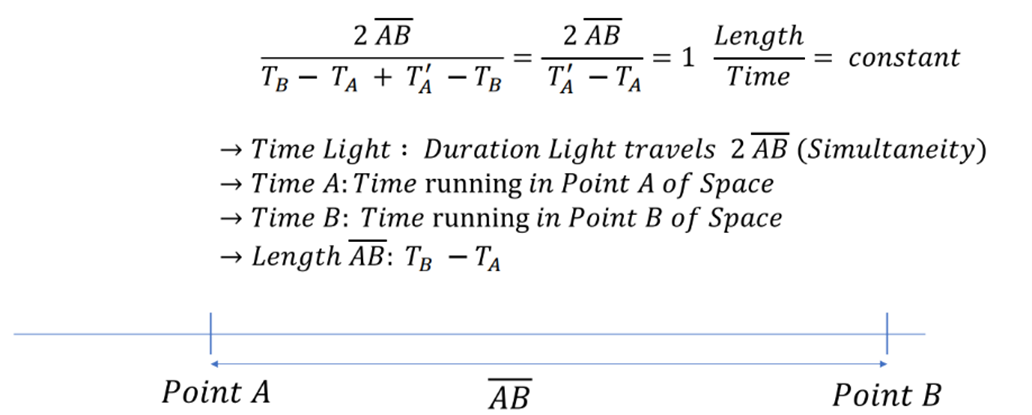
This construction contains a logical inconsistency: time is defined both as an unmeasurable flow in a mathematical point (absolute time) and as a measurable quantity between two points via the speed of light (relative time). The PVT rejects this double definition.
3. The Rational Definition of π
We propose to define the circle number not as an irrational constant, but as a rational function of three parameters:
$\pi(n, L) = \frac{n \cdot L}{D_n} = 1$,
where $n \in \mathbb{N}_{\ge 2}$ is the number of sides, $L \in \mathbb{R}^+$ is the side length (time-like), and $D_n = n \cdot L$ is the diameter (space-like).
This definition is illustrated for the continuous circle and for the quantized regular polygon.
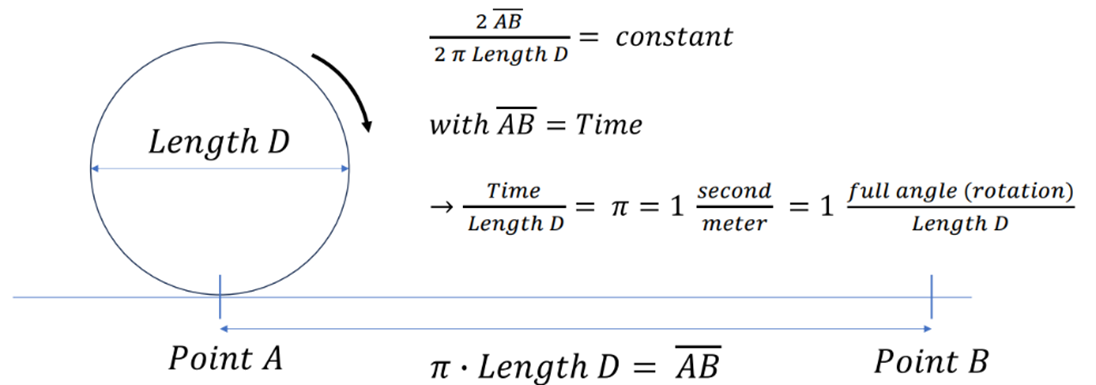
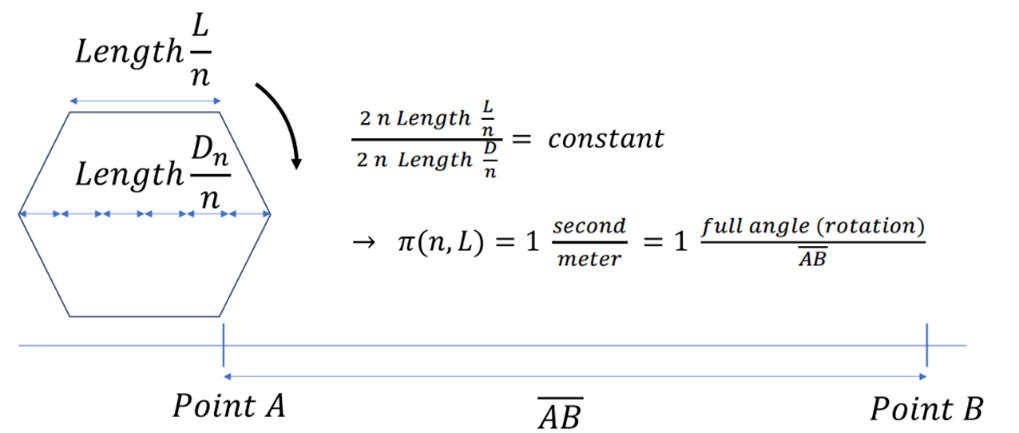
Figure 3: Quantized spacetime: regular n-gon with π(n, L) = 1. The integer n introduces explicit quantization while preserving rationality.
4. Connection to 12D Volume Dynamics and General Relativity
In the Panvitalistic Theory, physical reality is described by rational comparisons of 6-dimensional volumes under the constraint $\delta V = 0$. The definition $\pi(n, L) = 1$ fits naturally into this framework: the side length $L$ corresponds to a time-like angular degree of freedom, the diameter $D_n$ to a space-like length, and the integer $n$ introduces quantization.
This redefinition of π is not merely philosophical — it is mathematically necessary for the derivation of Einstein’s field equations from first principles [3]. The irrational, dimensionless π of standard mathematics blocks this derivation.
5. Experimental Consequence: The Local Nature of c
With $\pi(n, L) = 1$, the speed of light is no longer a universal constant but emerges from the geometry of Earth’s rotation:
$2\pi c = \frac{\text{Diameter}^2}{86400\,\text{s}}$
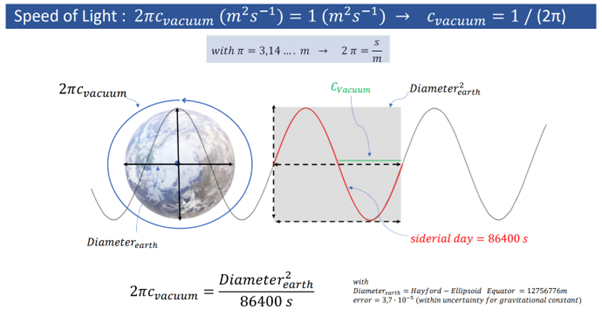
This confirms that $c$ and $G$ are local calibration constants, not universal invariants — a central prediction of the PVT that distinguishes it from standard general relativity.
6. Conclusion
By defining the circle number π as a rational, dimensioned geometric relation $\pi(n, L) = 1$ within 12D volume geometry, we achieve a rational foundation for both mathematics and physics. This redefinition eliminates hidden variables, resolves the quantum–GR contradiction, and enables the complete derivation of Einstein’s equations from the single axiom of rational volume comparison under $\delta V = 0$.
The wheel was never lost — it was only hidden behind an irrational number. Its rediscovery restores rationality to physics.
References
[1] M. U. E. Pohl, “Unified Principles of Nature: Solution to the Problem of Time”, Scientific GOD Journal, Vol. 10, No. 3, 2019.
[2] M. U. E. Pohl, “Search for the World Formula”, Scientific God Journal, 13(1):30–72, 2022.
[3] M. U. E. Pohl, “Deriving Einstein’s General Relativity from the Axioms of the Panvitalistic Theory (PVT)”, Preprint, April 2026.
[4] M. U. E. Pohl, “Testing the PVT Derivation of General Relativity: Mercury Perihelion Precession (Part II)”, Preprint, April 2026.